
The Phoney War
Disruption to transport is a major issue, disruption of the means of production will be the real crisis

In the months following the invasion of Poland in September 1939, Europe entered a period of eerie calm. Britain and France had declared war on Germany, mobilized their forces, and prepared for a major conflict, yet along the Western Front almost nothing happened. Leading to its nickname, Sitzkrieg (sitting war) or "Bore War”.
This phase, later known as the Phoney War, fostered a dangerous complacency by masking the scale and inevitability of the crisis that was already underway. Today’s commodity markets present a similar paradox. The great “Known Unknown” - major disruption in the Strait of Hormuz has happened: oil, LNG, LPG, fertilizer, sulphur, PetChem, refined products like diesel and jet fuel - all are seriously restricted. These are the oxygen of modern industrial (and urban) societies and they are literally being choked off.
Yet prices remain relatively subdued and the signals are widely dismissed as noise.
Just as in 1939, the lack of immediate escalation may not indicate stability, but rather a temporary calm before a far more significant rupture.

The Signs Are There
On Monday morning petrol prices jumped 20c/liter in Quebec - it was noticeable but still affordable. This is the Phoney War. Elsewhere, the drumbeats of approaching crisis are more obvious - hardest hit so far is SE Asia with knock on effects in Australia and New Zealand. Europe is also seeing price effects on struggling economies.
“The escalating war with Iran is pushing parts of the world into energy triage, forcing governments to choose where to cut demand or absorb costs, while prioritizing dwindling supplies.” (Iran war pushes countries into energy triage as they conserve power and curb soaring prices - AP)
Current signals point to a system tightening in ways that are not yet fully reflected in price. What is emerging is not demand destruction driven by higher costs, but physical scarcity appearing first in the most politically sensitive fuels.
The pressure is most visible downstream, where refining constraints and product shortages are binding more tightly than crude supply. At the same time, export restrictions and policy interventions are beginning to fragment what had been a broadly fungible global market. This fragmentation is going to be a major theme - and one I have predicted previously as a “theoretical” (here).
Substitution into alternative fuels (notably coal) is increasing, a sign that stress is already well advanced in some parts of the system. All of this is occurring against a backdrop of thin inventories and limited buffers, leaving little margin for disruption to escalate.
If this does not end up as an existential crisis - we can confidently predict that for all the talk of renewables, most sane countries will look to build bigger and better storage, as well as more diversified supplies.

1. LPG and gas shortages (India, South & Southeast Asia)
India is already facing an acute LPG shortage, hitting households, restaurants, and small industry.
Governments are prioritizing household supply, forcing cutbacks elsewhere in the economy.
Across Asia, gas outages and rationing behaviour (hoarding, panic buying) are emerging.
2. Refined product shortages (diesel, jet fuel, gasoline)
Diesel and jet fuel markets are tightening far more than crude, with sharp price spikes and constrained availability.
Australia is:
Releasing strategic stocks
Relaxing fuel standards
Warning of regional shortages, especially diesel1
Countries dependent on imports (Australia, Philippines, Bangladesh) are scrambling for replacement supply.
3. Export restrictions (refined products and energy nationalism)
China: temporary ban on diesel, gasoline, and jet fuel exports
Thailand: curbing exports to protect domestic supply
South Korea: reducing refinery output / limiting exports
India & Japan: becoming more cautious with exports
4. Coal substitution and price spikes
Coal demand is rising as LPG shortages force fuel switching.
Prices in India have jumped 20%+ in weeks due to substitution demand.
More broadly, gas/LPG disruptions are pushing structural demand into coal markets.
5. Low inventory buffers and emergency measures
Governments responding with:
Strategic reserve releases
Demand suppression (shorter work weeks, energy limits)
Without labouring the point, this does not stop with oil, LNG and refined products but spills over into many “second order” areas. For example sulphur is used in:
Fertilizers (phosphates, sulphuric acid)
Metals processing (copper leaching)
And petrochemicals
Refining constraints imply tighter feedstocks for:
Plastics
Chemicals
Industrial intermediates
One lever many western countries have is to reduce fuel (and/or carbon) taxes - this will help the affordability issue, but is unlikely to happen. Firstly, governments hate losing tax revenues. Secondly, there is a messaging issue - this kind of says that fuel/carbon taxes are part of a luxury belief system - only necessary when everything is smooth sailing3. Lastly, and probably most critical is that moderating the price of fuel would encourage usage - and if we believe that the price rises are a signal about future/imminent scarcity - using price to limit demand would seem tempting.
Unfortunately that logic can be pushed too far - a completely shut economy needs no fuel - but that is not a good outcome for obvious reasons.
More likely is they will use “price caps” - which delay the problem by shifting the cost to general taxation - where it is less visible, but remains toxic to the general economic health.

Transport Disruption vs Attacking Production
With a few minor exceptions the current energy crisis is currently one of transportation4. Some oil is still transiting the SoH - notably oil heading for China. Incidentally, China has been stockpiling oil for the last 18 months - so despite needing 11 million bbls/day of imports it probably has over 100 days of cover (unlike most western countries who have bought into the “Just Stop Oil” BS).
Unwinding transport bottlenecks is relatively doable. The next phase is hitting the upstream (and mid-stream) infrastructure.
If/when this conflict escalates - attacks on oil and gas production facilities in the broader Gulf will be the start of the next phase. Maybe the end of the beginning? Certainly the end of the Phoney War.
Even as I am writing, it appears that this new phase may have started.
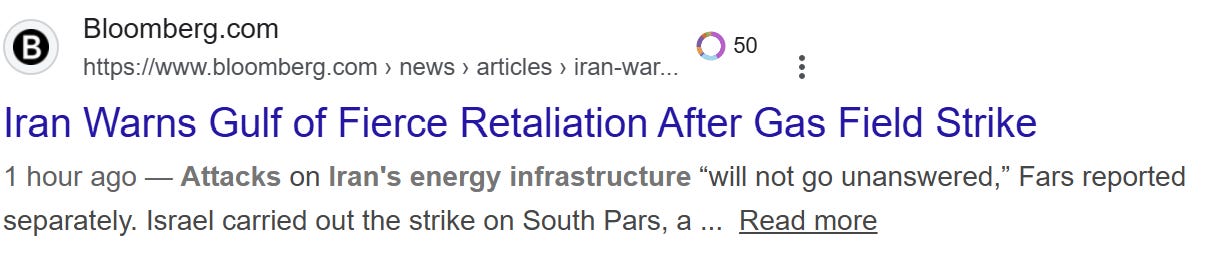
Those fuel price-caps are going to get expensive quickly.

Oil Price - You Ain't Seen Nothing Yet

The price of oil has “ripped up” since the start of hostilities in the Gulf.
Which of course has led to panic buying and sales restrictions (AUS$50 per customer in some gas stations).
“India is considered one of the most vulnerable countries to an oil shock because it imports almost 90% of its crude and about 50% of its natural gas. India imports more than half of its crude from the Middle East where the U.S./Israeli war against Iran has disrupted export flows. India's oil reserves are currently only enough to last 20-25 days.” (source)
Which is probably the reality - but will not sit well with many ideological energy policies.
As I noted last week, the question of how much oil and gas (LNG) are being disrupted can be seen in different ways. For LNG comparing the volumes that normally transit the Strait of Hormuz to world LNG volumes is the correct proxy - and it is about 20%. For oil it is more complex as the oil volumes should be compared to all exports, not to total global production (since a lot is used in the countries where it is produced. In this case the volume disrupted could be up to 40% - in other words, a large part of globally traded oil comes out of the SoH region.
At least we have some funny movies to watch https://fasteddynz.substack.com/p/idiocracy-20-zoolander-20