

Given how quiet it is in the energy space at the moment, let’s take a moment to enjoy the Moon and the historic Artemis II space flight that is taking humans further from Earth than ever before.
I was reminded of this by a tweet (that appears to have been rapidly deleted) that was questioning, innocently enough, what the light source was for the photos that Artemis captured of the dark side of the moon.
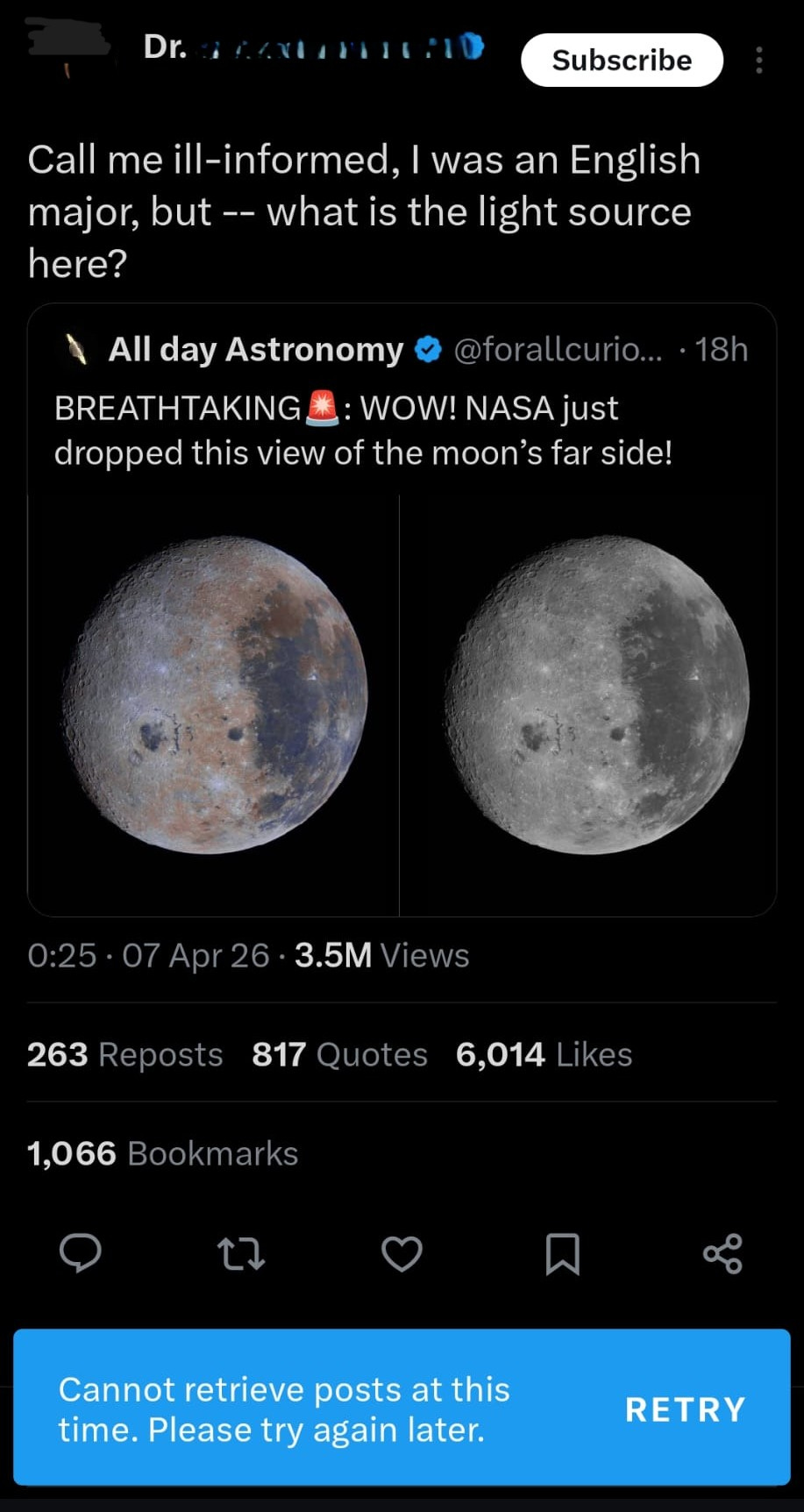
You can see why this might be confusing - it is the “dark side” after all, and suddenly we have photos of it lit up like a British tourist on a beach in Greece.
You can also guess why the original poster rapidly binned the tweet.

The “Dark Side” isn’t of course dark. It is however, always facing away from us - so in terms of information it is “dark”. Incidentally, this is one of the explanations for the naming of the European “Dark Ages” - that it has almost no records - so is also “dark” in an information sense. With the mystery of the light source sorted1 we can marvel at the fact that the rotation of the moon around the earth is such that only one side is always facing us, and it is not simply spinning like a camembert on ecstasy.
The Far Side and Synchronous Rotation
The idea of a permanently dark hemisphere is a misnomer; indeed, in the original post above, the photo is captioned “far side” not “dark side”.
The Moon is tidally locked to Earth, meaning it rotates once on its axis in the same time it takes to orbit, so the same face is always turned toward us. This seems like a wildly unlikely coincidence, but sadly for the woo-woo moon worshipers it is not a coincidence but the outcome of gravitational interaction over long periods, which has dissipated rotational energy and settled the system into a stable configuration.
The far side is therefore not dark; it experiences day and night just as the near side does, receiving the same sunlight over time. The distinction is not between light and darkness, but between what is visible from Earth and what is not.
Tides and Time
Since I am never far from thinking about energy, it is amusing to note that the attractive but unlikely-to-ever-scale-beyond-a-few-pilot-projects Tidal Power is an exception in that the energy is lunar rather than solar. The tides are driven primarily by the gravitational pull of the Moon, with the Sun playing a secondary role in shaping the amplitude. Almost everything else in our energy system traces back, directly or indirectly, to solar input. Oil, gas, and coal are stored sunlight via photosynthesis and geological time. Wind is driven by solar heating of the atmosphere. Solar is, well solar. Even hydroelectric power depends on the solar-driven water cycle.
The only other major exception to this solar framework is nuclear, where the energy stored in uranium is of a fundamentally different origin. It is not energy recently captured from the Sun, but energy bound within the atomic nucleus, forged in ancient astrophysical events that predate the formation of the solar system. Heavy elements such as uranium were created in extreme environments, most likely supernovae or neutron star collisions, and incorporated into the material from which Earth formed. In that sense, nuclear energy is not part of the current solar income but a drawdown of a much older inheritance, a residual from the same cosmic processes that followed the Big Bang and seeded the universe with the elements.
Tides
The other interaction of the moon on my energy journey was quite unexpected. When exploration oil wells are drilled you can detect the presence of hydrocarbons through a series of indirect measurements (“logging”) in the well bore. Whilst expensive and somewhat risky, flowing oil to the surface is the gold-standard for proving up an exploration well. As part of this process, the extraction of even relatively small volumes of fluid perturbs the pressure regime. Shutting in the flow and measuring the pressure build up can tell you a lot about the connected volumes, the permeability and so on. The pressure variations are often very small, so the analysis is done on the derivatives of the time and pressure. Many fields around the world show tidal variations in the pressure build up curves2.
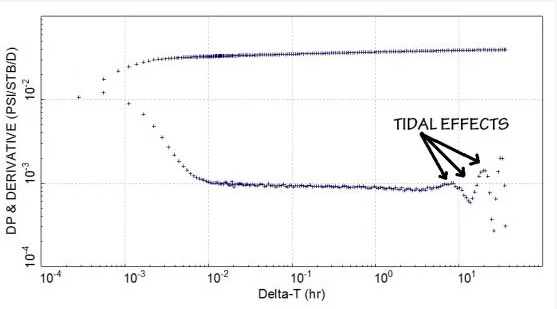
When I saw this I was working offshore Angola, and assumed it was the tide affecting the 1500m of water overlying the 800m of sediment. It turns out that tidal effects are seen in onshore fields also. The moon’s gravitational pull affects the fluids locked in the porosity of the subsurface directly. Pretty wild.
Well, That Fits
Another “fun Moon fact” is the apparent match in size between the Moon and the Sun. When we witness a solar eclipse, it is remarkable just how perfectly the moon “fits” over the sun. For this to occur you need there to be a nice match of distance and size so there is an appearance of size equality. If the moon were much bigger or smaller, or closer or further away it wouldn’t work.
This coincidence is real enough to produce total solar eclipses, but it is neither exact nor permanent. Both bodies subtend roughly half a degree in the sky, which allows the Moon to cover the Sun’s disk from Earth, yet small variations in distance mean that sometimes the Moon is too small and a ring of sunlight remains (an annular eclipse). Damn that eliptical orbit.
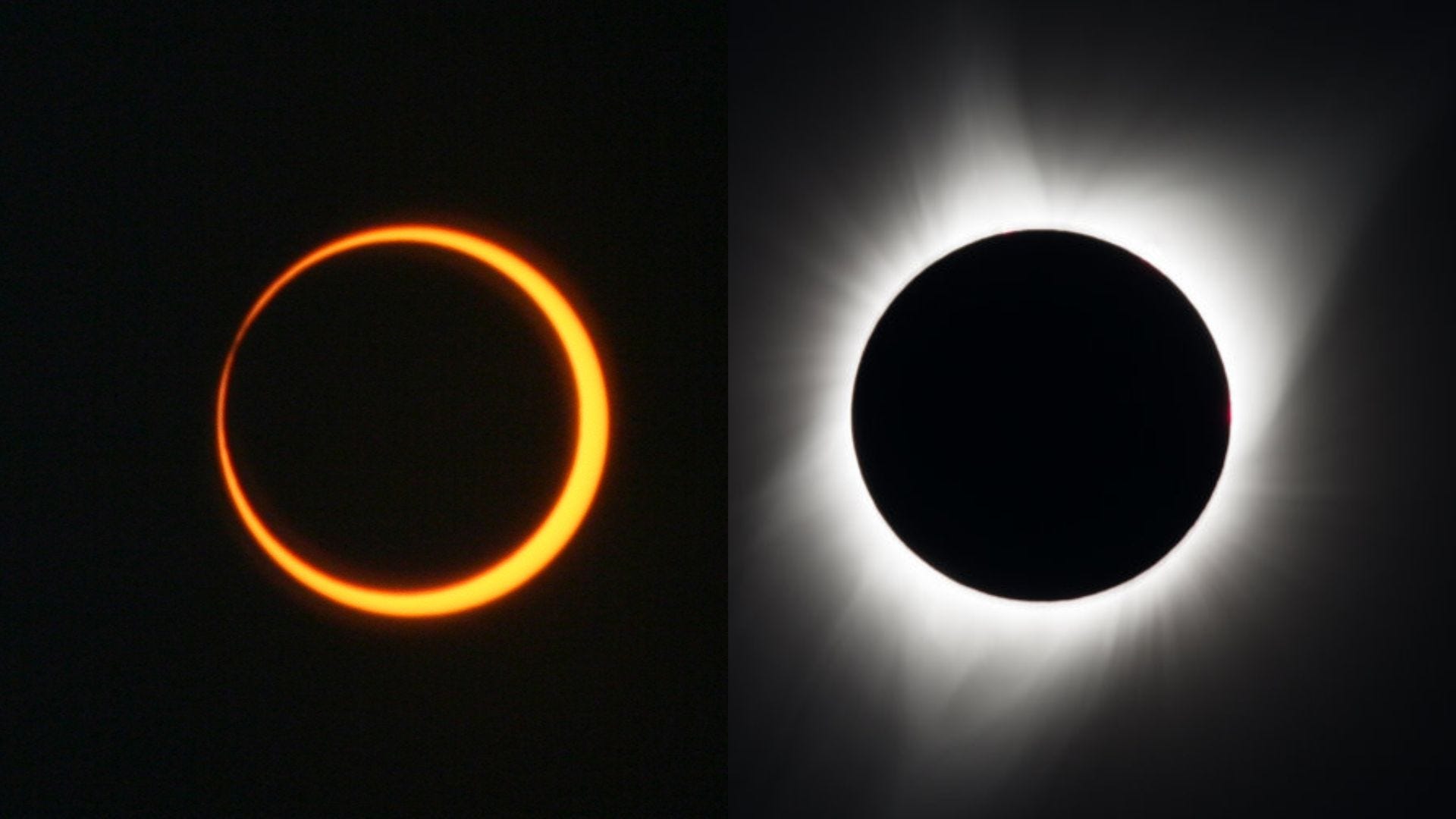
For those who enjoy total eclipses, get some soon. The Moon is receding from Earth by a few centimetres each year, so in the distant past eclipses would have been uniformly total, while in the distant future they will be exclusively annular. What looks like a finely tuned balance is better understood as a moment we happen to inhabit.
And that is a happy coincidence
I hate to be that guy, but The Sun….
These tidal effects need to be removed so that the reservoir pressure-volume effects can be analysed.
This was fantastic...Thanks
I had never thought of Uranium sources, very interesting.