
China Syndrome - Demand and Command
How the Iran war has revealed China as the world’s swing consumer

In every previous oil shock, the market has asked the same question: who is the swing producer? Who has the spare capacity, the political will to ramp-up production and put barrels back into a broken market? For as long as I can remember the answer has been “Saudi Arabia”.
The 2026 Gulf war has revealed a different dynamic. This crisis has no swing producer worth speaking of; most of what used to be called OPEC spare capacity sat on the wrong side of the Strait of Hormuz, which is rather like keeping your fire extinguisher inside the burning building. Instead, it appears that there is a swing consumer.
The numbers first
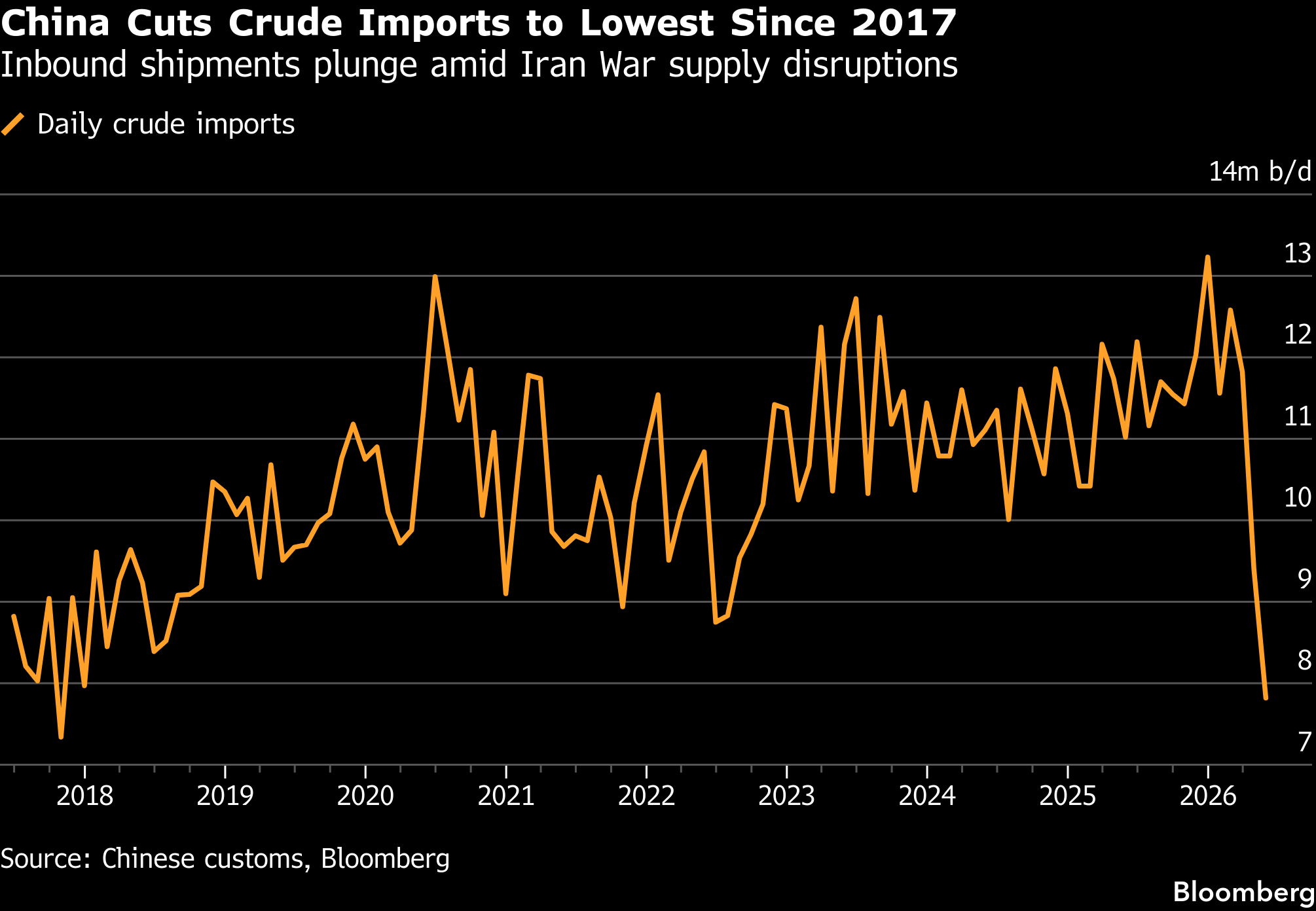
China imported an average of 11.6 million barrels per day over 2025 on the customs measure, which counts everything: roughly 10 mmbbl/d arriving by sea plus around 1.5 mmbbl/d by pipeline from Russia, Kazakhstan and Myanmar. Then, in the two months before the war, imports surged. Customs recorded 11.99 mmbbl/d over January-February, up 15.8% year on year, with seaborne arrivals alone hitting 11.47 mmbbl/d in February per Kpler.
Hold that surge in mind; we will come back to it.
Then the war started, and the buying stopped. Seaborne arrivals collapsed to 6.36 mmbbl/d in May, the lowest since October 2016, with preliminary Kpler data for June pointing to around 6.4 mmbbl/d. On the all-inclusive customs measure the fall was from 11.99 to 7.8 mmbbl/d in May, an eight-year low. The two series tell one consistent story: seaborne buying was cut by roughly 5 mmbbl/d peak to trough, total imports were cut by roughly 4, and the difference is simply import pipelines, which kept flowing and are conveniently immune to anything happening in the Strait of Hormuz.
Call it a five million barrel per day reduction in seaborne buying, in roughly three months. Rory Johnston at Commodity Context, whose charts on this are the best in the business, calls it the 10,000 lb gorilla in the room - the single largest reason the world avoided the demand-destroying prices that a months-long Hormuz closure was supposed to make inevitable. For scale: five million barrels per day is more than Japan’s entire national consumption. It vanished from the buy side of the market in a matter of weeks.
To put it another way: the loss of Gulf exports was the largest supply shock in the history of the oil market, and its mirror image, the largest and fastest voluntary import reduction in the history of the oil market, happened at the same time, in the same place, and mostly cancelled it out (when seen in conjunction with emergency storage releases elsewhere).
Everything we knew about demand was wrong. Or was it?
The conventional wisdom, taught to every energy analyst since 1973, is that oil demand is inelastic. People do not stop driving to work because petrol is expensive. Demand destruction is real but it requires genuinely punishing prices sustained for a long time, and the historical benchmarks for “punishing” are higher than most people remember. The 2008 spike to $147/bbl is roughly $215-220/bbl in today’s money. This war saw Brent briefly above $150 in the first panicked month, then settling into a $100-120 range, and now, remarkably, languishing in the low $70s as Hormuz tentatively reopens. We never got anywhere near the real price levels at which textbook demand destruction kicks in. I made this point at the time in Waiting for Godoil.
So how did the world’s largest importer cut its buying by five million barrels a day without $220 oil? A number of explanations are circulating, and most of them are being misread.
The EV explanation. The Energy Transition commentariat leapt on this immediately: China’s electrification did it. This gets the direction right and the magnitude and timescale badly wrong. EVs are a large and growing share of Chinese new car sales, and gasoline demand was indeed already past its peak. But new sales take years to turn over a fleet of 300-plus million vehicles. Electrification is why Chinese oil demand was flat-to-declining at the margin; it is arithmetically incapable of explaining a five million barrel per day drop in crude buying over a few weeks. Nobody scrapped a hundred million petrol cars in March.
The price destruction explanation. This one fails because Chinese consumers largely did not see the price signal. Beijing’s retail fuel pricing mechanism caps pass-through at high crude prices, and early in the war the authorities reportedly went further, ordering private refiners to maintain gasoline and diesel supply even at a loss, on pain of losing their crude import quotas. Capping domestic prices is the exact opposite of price-driven demand destruction. Whatever reduced China’s crude appetite, it was not the invisible hand slapping Chinese motorists. That said, there was a potential drop of about 5% in gasoline usage as slightly higher prices did reduce demand - however, this is a very long way from the 5mmbbls/d drop in imports.
The teapot explanation. Here the evidence is actually reasonably solid, which surprised me given how opaque most things are. Shandong’s independent refiners were losing an estimated 500-600 yuan ($74-88) per ton of crude processed by May, and run rates have fallen to 50.5%, the lowest since August 2017, per JLC data - lower even than during Covid. State refiner margins hit an eye-watering minus $60/bbl in mid-April per Oilchem assessments. So yes, refiners cut runs, and cut crude purchases accordingly.
Negative magins for refiners are the direct result of the retai price cap. Refiners buying $120 crude and selling capped products lose money by construction. Beijing first ordered them to eat the losses, then apparently tolerated run cuts once product inventories were judged adequate. That is a system being managed, with the “market signal” of negative margins functioning as an instrument of rationing crude purchases while protecting the consumer. Whether one calls this central planning working or central planning improvising is a matter of taste. Either way, the teapots did not spontaneously discover capitalism; they were handed a loss and told when they were allowed to stop taking it.
Coal-to-liquids. Online commentary has made much of China’s synthetic fuels capacity. The industry is real and growing - China feeds roughly 380 million tonnes of coal a year into chemical and fuel production - but its largest CTL plant, Shenhua Ningxia, produces about 100,000 b/d. The whole coal-to-X complex covers perhaps 6% of import needs and cannot be scaled in weeks. It is a genuine strategic hedge for the next decade, and largely a rounding error for this crisis.
The bloated baseline
Which brings us to the explanation I find most convincing: the pre-war import number was never a “true” demand number.
The EIA estimates that China added an average of 1.1 million barrels per day to strategic inventories through 2025, taking total crude stocks (government plus state-directed “commercial” storage, which a January law formally merged into a single national reserve concept) to nearly 1.4 billion barrels by December. Kpler pegged onshore inventories at 1.2 billion barrels in January 2026.
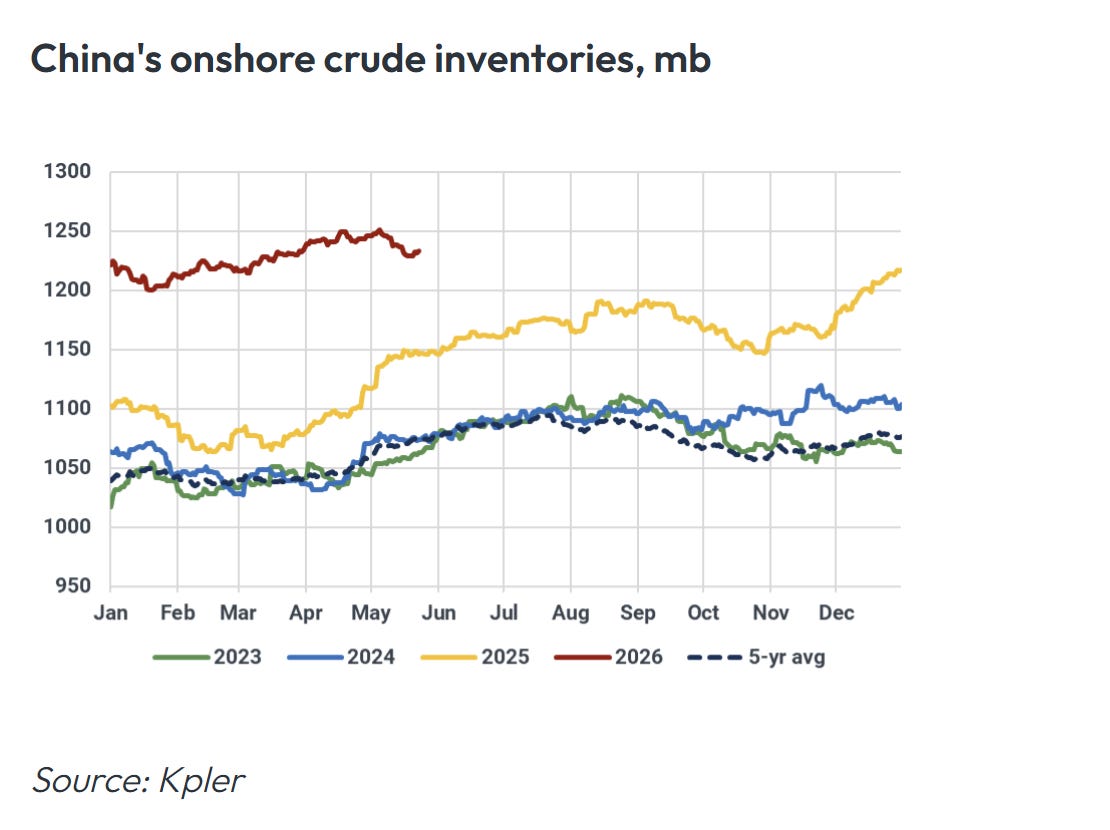
China does not publish these figures; everything is inferred from tanker tracking and satellite photos of tank farm roofs. One can debate the numbers, but the sheer scale of this reserve, and the clear build in 2025-Q1 2026 is evident.
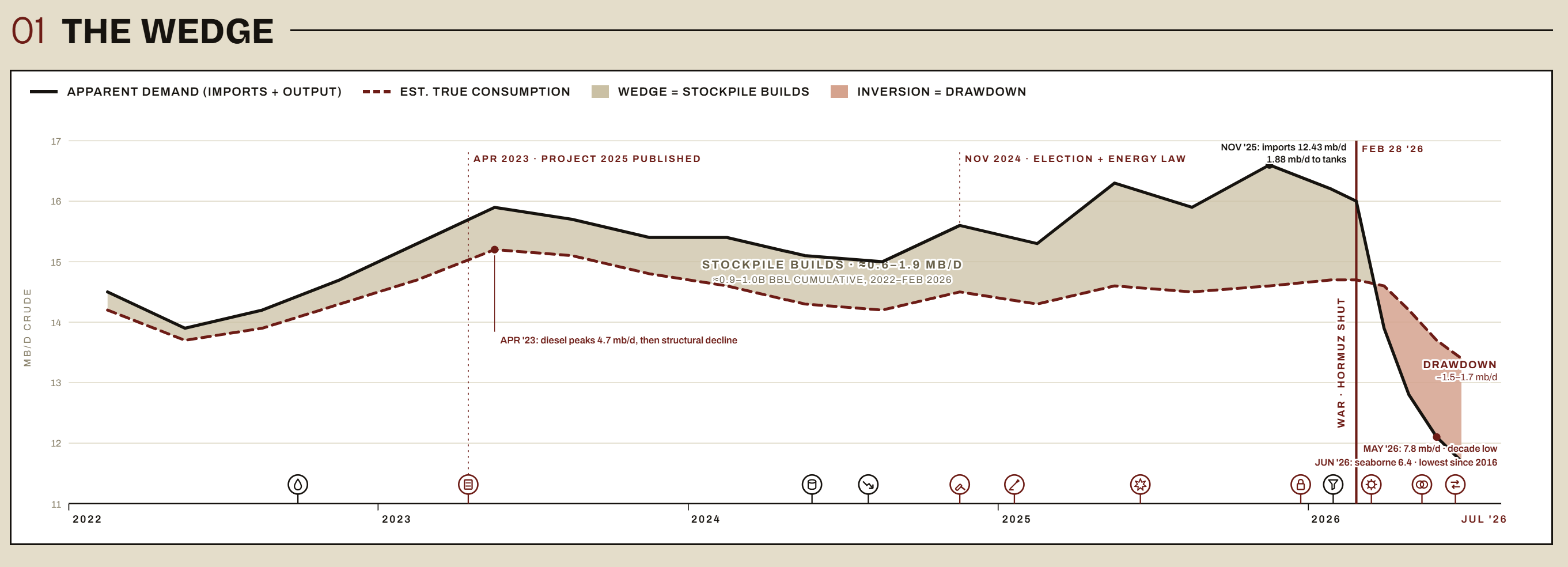
So of the 11.6 mmbbl/d of 2025 “demand”, something like 1 to 1.5 million barrels was going straight into tanks, and the proportion was higher still in the pre-war surge months. The market has spent well over a year reading a stockpiling programme as consumption. When the war started, Beijing could cut visible imports by that amount at zero cost to the real economy, simply by not stockpiling. As a second step, reversing the flow and drawing the tanks down provided supply and allowed for further import cuts.
This is where days of cover arithmetic gets interesting, and why the naive calculation misleads. Measured against pre-war gross imports of 11.6-12 mmbbl/d, 1.4 billion barrels is about 120 days - respectable, unremarkable. But that denominator is wrong twice over. Strip out the stockpile build and true import need was maybe 10 mmbbl/d. Then note that imports have not stopped: 6.5-8 mmbbl/d is still arriving, via pipelines, Russian and Atlantic Basin cargoes, and whatever dark fleet arithmetic one cares to assume. The actual net draw on inventories is plausibly in the 2-3 mmbbl/d range, and lower still once refinery run cuts and genuinely weaker demand are netted off. Against a 2 mmbbl/d draw, 1.4 billion barrels is 700 days. Against 1.5 mmbbl/d, it is over 900. I wrote about the general misunderstanding of “days-of-cover” denominators in End of Days (of Cover); China is the same fallacy in the other direction. Beijing is not running out of oil this year, or next year, and it knows it. There are even reports the government SPR sites continued adding barrels during the war while refinery-held stocks did the drawing.
Sitting pretty
Why was China over-buying in the first place? The charitable read is opportunism: oil at $60 was cheap, so they bought it, as anyone sensible would. But recall that January-February surge I asked you to hold in mind. Imports jumped 16% year on year in the weeks before the first strikes, and analysts were explicit at the time that Beijing was accumulating stockpiles in anticipation of a US attack on Iran. This was not a lucky accident of cheap oil; the final pre-war sprint was deliberate positioning for a war Beijing saw coming. The less comfortable read follows naturally: a country planning for the contingency of a Taiwan invasion, and the naval blockade of Middle East supply lines that would follow it1, needs exactly this reserve, and has now been gifted a full-scale live rehearsal. The war in Iran let Beijing dry-run an oil embargo against itself, on its own terms, with the ability to call it off at any moment. Every planner in the PLA logistics directorate should be sending thank-you notes to Washington. The result of the experiment: China lifted some fuel export restrictions on June 30, a country under an effective partial oil embargo confident enough in its position to resume selling refined products to its neighbours. That decision is the single most informative data point of the entire crisis, and it went almost unremarked.
Since writing this article I have come across this excellent (and better quantified) version of the same story: THE PHANTOM BARRELS demand that never was: a working thesis · jul 2026
What happens when China comes back?
The bulls’ great hope is the restocking bid: China must eventually refill what it drew, other countries will want bigger SPRs of their own (a point I made in Unrefined Behaviour about products, which applies equally to crude), and the barrels that never left the Gulf during the war have been “made up” from global inventories that also need rebuilding. Kpler’s analysts argue the real shock may only begin when China returns. Johnston notes the paper market is currently pricing a mini-glut as “flush supply” comes from recovering Hormuz flows meets a Chinese buyer’s strike that has not ended.
But there is a bearish reading the bulls should sit with. A swing consumer, by definition, swings both ways, on its own schedule. China demonstrated it can absent itself from the market for months; it can equally choose to return slowly, buying only on weakness, refilling tanks at $70 rather than chasing cargoes at $110. The entity that did not panic-buy during the largest supply disruption in history is unlikely to panic-buy during the recovery. “China comes back” may be less a wave than a gentle tide, and tides do not produce price spikes.
And a final thread, which I will keep in the footnotes where speculation belongs2: the possibility that none of this was improvised.
Almost no demand was destroyed by price in this war. Rory Johnston went on Odd Lots to discuss, with commendable honesty, why his $200 oil call did not come true; the answer, overwhelmingly, was China (coupled, of course, with the global response). And in full transparency: I was in the $150-$200/bbl oil camp also. In past shocks we counted Saudi spare production capacity. In this one, the spare capacity was a billion barrels of pre-positioned Chinese storage and a command economy’s ability to decide, by administrative fiat, how much oil its economy would demand this month. The swing producer era gave the market a floor. The swing consumer era gives it a partial ceiling.
It appears that we have simply swapped which petrostate function sits inside the price and we kind of found out by accident.
Related reading from the archive
Waiting for Godoil - the paper vs physical divergence and why the curve keeps rediscovering reality one roll at a time. Directly sets up footnote 2.
End of Days (of Cover) - days of cover depends entirely on the denominator you choose. The US analysis; this article is the Chinese mirror image.
Oil Price - You Ain’t Seen Nothing Yet - the early-war price piece, including the inflation-adjusted context.
Unrefined Behaviour - refined product security and export restrictions, the other half of China’s wartime management.
Complacency Syndrome - the “unprecedented crisis being shrugged off” theme, which this article partly answers: the shrug had a reason, and the reason was Chinese storage.
End Of The Line - Australia and New Zealand at the far end of the supply chain. China’s product export resumption is the direct counterpoint: it is partly why the rest of Asia was “saved”.
Footnotes
On which note, the UK’s cession of the Chagos Islands to Mauritius deserves more attention than it received. Diego Garcia is the base from which any Indian Ocean interdiction of China-bound oil (think Strait of Malacca, or the Indian Ocean approaches to it) would be mounted and supplied. The base is leased back for 99 years, but sovereignty now rests with a small state over which Beijing has been assiduously growing influence. In a world where China’s oil lifeline runs across the Indian Ocean, handing away legal certainty over the West’s only significant base astride that lifeline may prove a bigger blunder than it first appeared. ↩
Speculation, clearly labelled as such. There has been sustained jawboning of the oil price from Washington, noted even by Bloomberg’s Odd Lots as one reason prices stayed contained, and oil bulls have been repeatedly and expensively wrong-footed at each contract roll, to the point where some market participants argue open interest has thinned enough that price discovery in the benchmarks is impaired (a theme covered in Waiting for Godoil). Meanwhile China managed the physical market down by five million barrels a day. If you wanted to design a two-handed operation to prevent an oil-price-led global recession, one that would have hammered China’s export economy hardest of all, it would look like this: the US managing the paper, China managing the physical. I have no evidence of coordination, and neither does anyone else. But interests can align without a phone call, and this year they aligned perfectly. ↩
Really informative article. A lot to consider, most of it seems quite rational. Thanks
Thank you for this incisive analysis of China as the world's swing crude oil consumer.